
Making Space
On acceptance, non-judgment, and what happens when you loosen your grip

Last week, I crossed the 14th Street Bridge into Washington, D.C., entering what felt like the epicenter of everything that’s chaotic in our world right now.
The struggling Potomac below. The still-standing monuments ahead. And between me and them — a river of brake lights that gave me an opportunity to practice what I preach. Acceptance. Loving kindness. Patience.
I don’t always remember to practice.
That particular morning I was somewhere else entirely — running scenarios in my mind, crafting arguments for a project that kept getting blocked, rehearsing conversations with people who resisted my idea. My chest was tight. My shoulders were up around my ears. I hit the brake pedal harder than I needed to.
I caught myself clenching the steering wheel with both fists.
And then I thought of Viktor Frankl.
Frankl was an Austrian neurologist and psychiatrist who lost nearly his entire family in the Nazi concentration camps. After liberation, he could have spent the rest of his life in rage, in grief, in permanent victim consciousness. Instead, he wrote one of the most important books of the 20th century: Man’s Search for Meaning.
His central insight was this: “Everything can be taken from a man but one thing: the last of the human freedoms — to choose one’s attitude in any given set of circumstances, to choose one’s own way.”
It’s not what happens to you. It’s how you meet it.
My nervous system doesn’t know the difference between gridlock and genuine danger. It just knows threat. The alarm is the same ancient mechanism — lit up, scanning, ready to fight a battle that may exist mostly in my mind. And somewhere in that response, Frankl’s words found me. He understood this mechanism before any of us had language for it. He left a map for exactly this moment — not about the magnitude of the circumstance, but the choice that lives inside it.
On the 14th Street Bridge, in traffic I cannot control, heading toward uncertainty I cannot fix, Viktor Frankl is one of my spiritual teachers.
I loosened my grip.
When I remember to leave more than a car-length distance between my bumper and the one ahead, something shifts. Not just in my car. In the flow itself.
People can move — left toward the White House, right toward the Capitol — through the gap where I made room.
Crawling together beats being stuck in a standstill.
The driver behind me didn’t appreciate the space I was leaving. He made that clear.
My first instinct was judgment. But then I caught something: I was doing the exact same thing to the people blocking my project at work. Assigning them a story. Certain I knew their motives.
What if I don’t have the full picture?
What if there are factors I’m not aware of?
What if my project has real problems I haven’t been willing to see?
The uncertainty didn’t disappear when I asked those questions. But something in my chest did.
There’s a difference — a palpable, physical difference — between thinking and being.
When I’m in my head, I’m in my neck and shoulders. Running scenarios. Building cases. Defending positions.
When I drop into my heart — down through my chest and into my solar plexus — something opens. A spaciousness that makes room for what’s actually happening instead of the story I’ve been telling. The scenarios quiet. What’s true becomes more clear.
Frankl called it finding meaning in the moment. I felt an expansion in my heart.
The hardest part is remembering to make the move when something pops up and provokes me. The driver behind me. The meeting that went sideways. The news playing in the background. Something catches my attention and I clench.
But if I can remember — even once, even imperfectly — to pause before I react, something loosens. Not everything. Just enough.
Enough to move.
Moving slowly across the bridge, I’m still traveling faster than the Buddhist monks Annie and I followed this month across the National Mall to the Lincoln Memorial.
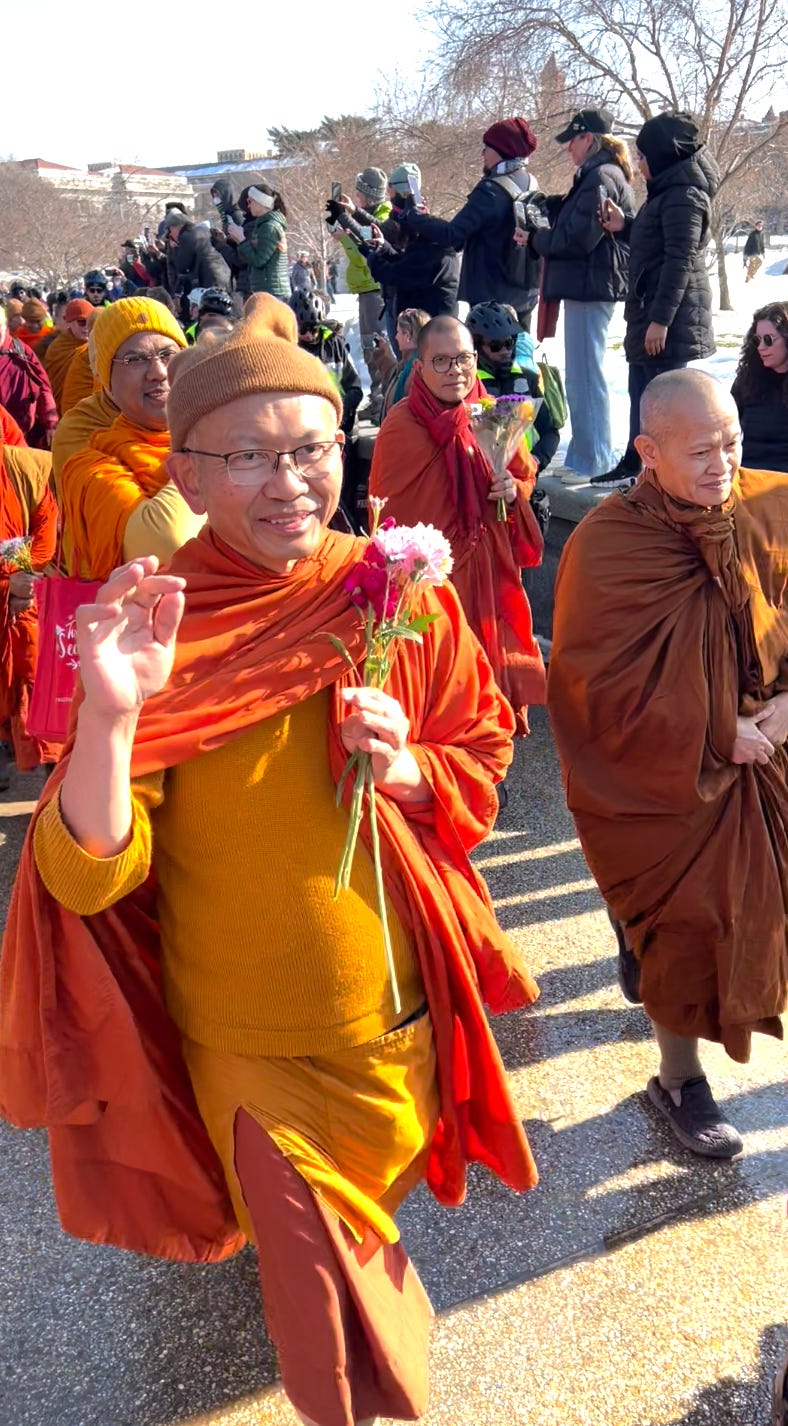
They had walked for more than 100 days from my native state of Texas, crossing the Potomac River that was carrying about 250 million gallons of raw sewage from one of the largest spills in American history.1 Sacred and broken. Both true.
When I arrive at work, join my colleagues in the elevator, and ask them about their commute, I can see that same sacred and broken paradox in their experiences.
Those who found a moment of grace somewhere between their front door and our building have something lighter in their eyes.
And the ones who fought every inch of the way carry more than just their lunches and laptops. I can see what the commute did to them. What they couldn’t put down.
I carry both versions in myself.
Once we all arrive, something shifts. We’re not commuters anymore. We’re people showing up — together — in service of others. What I carry in my heart is the best thing I have to offer to our cause. Not my arguments. Not my strategies.
Just my presence.
My heart.
World peace starts with a ripple from a single chest.
And the beautiful, and terrifying, post-pandemic truth: We spread what we shed.
Where do you find yourself clenching this week?
What would it mean to loosen your grip, just slightly?
Who has helped you find meaning like Frankl found in his darkest days?
https://thehill.com/policy/energy-environment/5736277-dc-water-sewage-overflow/
Amen.
Thank you again Bob. For the process and the questions. I will carry them with me today